Dispelling the "Scratch-Proof" Myth: The Truth About Ceramic Coatings
By Verified Team | 5 Min Read
back to resourcesLet’s establish the truth immediately: no ceramic coating on the market is "scratch-proof." If a detailer promises you immunity from key scratches, stone chips, or the destructive brushes of an automatic car wash, they are lying to you to secure a deposit. As professionals who spend hundreds of hours a month correcting paint, we see the aftermath of these false promises constantly. A professional-grade ceramic coating is the ultimate chemical barrier for your clear coat, offering unmatched hydrophobics and UV resistance—but it is not a suit of armor. At Verified Detailers, we believe in technical honesty over aggressive sales tactics.
1. The 9H Hardness Illusion
You have likely seen advertisements boasting about a coating’s "9H Hardness," heavily implying that the product is as hard as a diamond. This is a deliberate manipulation of testing standards.
The detailing industry uses the Pencil Hardness Scale, not the Mohs Scale used for minerals. "9H" simply means the coating resisted scratching from a 9H graphite pencil. More importantly, consider the thickness. A professionally applied ceramic coating cures to a thickness of roughly 1 to 2 microns. Even the hardest Silicon Dioxide (SiO2) resin cannot stop the mechanical impact of a stone chip at 100km/h or a dirty wash mitt ground into the panel, simply because the protective layer is thinner than a human hair.
- What "Hardness" Actually Means: It refers to the coating's ability to resist micro-marring (the very fine, spider-web scratches caused by drying towels), not deep mechanical gouges.
- The Mohs Myth: 9H on a pencil scale is roughly equivalent to a 3 or 4 on the Mohs scale—roughly the hardness of a fingernail.
- The PPF Comparison: If you want true mechanical protection against stone chips and key scratches, you need Paint Protection Film (PPF), which is around 150-200 microns thick.
The Bottom Line: If a rock has enough force to dent the steel panel underneath your paint, a 2-micron layer of liquid glass was never going to stop it.
2. What a Ceramic Coating Actually Does
If it doesn't stop scratches, why do we recommend it as the industry standard? Because a true ceramic coating provides chemical superiority that waxes and polymer sealants simply cannot match.
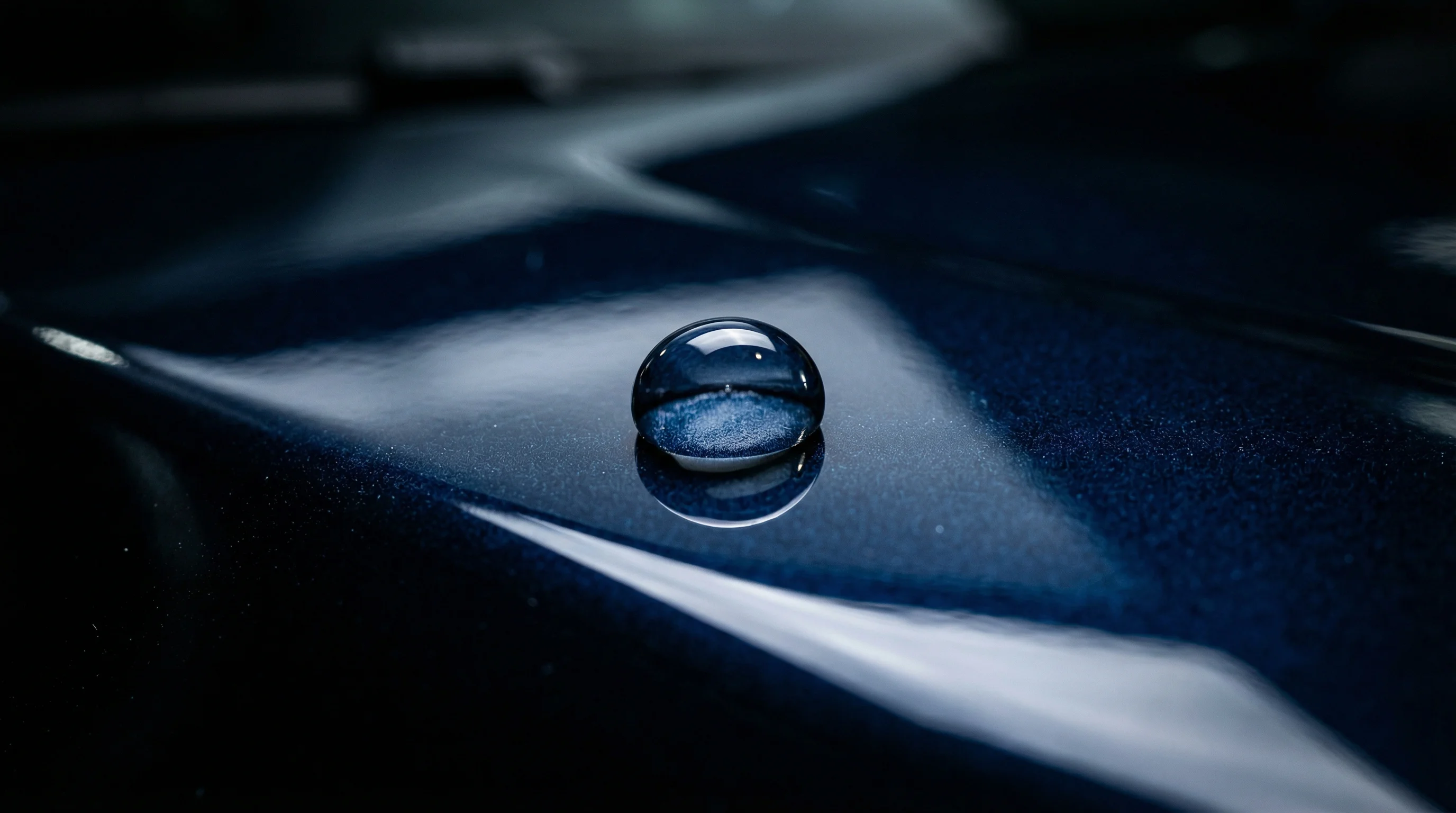
When SiO2 cures, it forms a permanent, glass-like bond with your factory clear coat. This creates a sacrificial layer that stops highly acidic environmental threats—like bird droppings, bat sap, and bug splatter—from instantly etching into the paintwork. Furthermore, it creates extreme surface tension (hydrophobics). Water and dirt cannot easily stick to the surface, meaning the car stays cleaner for longer, and your routine maintenance wash goes from a two-hour chore to a safe, 30-minute process.
- Chemical Resistance: True ceramics are highly resistant to pH extremes (pH 2 to pH 12), protecting against harsh degreasers and acidic rain.
- The UV Shield: It acts as permanent sunscreen for your car, absorbing UV radiation and preventing the clear coat from oxidising and peeling—a critical factor on the Australian South Coast.
- Gloss Enhancement: The high refractive index of ceramic resin provides a "permanently wet" look that waxes can only mimic for a few weeks.
Pro Tip: The true ROI of a ceramic coating is in time saved during maintenance washing and the long-term prevention of clear coat failure, not invincibility.
3. The Danger of "Spray-On" Ceramics
The market is currently flooded with $50 "ceramic spray sealants" that claim to offer the same protection as a $1,500 professional installation. This is chemically impossible.
Consumer-grade spray sealants contain incredibly low volumes of active SiO2 (often less than 5%). They are suspended in water or mild solvents to make them easy for anyone to wipe on and off. A professional-grade coating is a "high-solids" liquid containing 70% to 90%+ SiO2 suspended in potent carrier solvents. When a professional coating cures, it crystallises into a hard, durable layer. When a spray sealant dries, it leaves a microscopic film that provides water beading for a few months before washing away entirely, leaving your asset exposed.
- The Illusion of Protection: Spray sealants trick owners into thinking their paint is protected long after the product has structurally failed.
- The "High Spot" Risk: Applying a high-solids professional coating requires a climate-controlled environment, dedicated lighting, and a trained eye. If applied incorrectly, it flashes too quickly and leaves permanent, cloudy smudges ("high spots") that must be machined off.
- The Preparation Mandate: You cannot spray ceramic over dirty paint. The bulk of a professional's fee covers the hours spent chemically decontaminating and machine polishing the clear coat before the coating is ever opened.
The Reality: You cannot buy professional-grade ceramic protection in a spray bottle from an auto parts store.
4. Why We Verify the Coating Chemistry
The detailing industry relies heavily on branding, but the truth is simple: the installer matters significantly more than the brand of coating they use.
The most expensive ceramic vial in the world will fail within six months if it is applied over paint that hasn't been properly prepped. At Verified Detailers, we audit our network to ensure they are executing the unglamorous, foundational work required for a coating to bond properly. We also verify that our operators provide honest, realistic expectations for durability—usually 3 to 5 years—rather than pushing deceptive "lifetime warranties" that trap you into paying for expensive, mandatory annual inspections just to keep the warranty valid.
- The Preparation Audit: We ensure our partners perform full iron decontamination and mechanical polishing to provide a pure surface for the coating to bond to.
- Warranty Transparency: Verified operators don't sell infinite lifespan myths; they sell honest, measurable chemical protection.
- The Value Proposition: Investing in an audited professional means you are paying for the mastery of the preparation and the integrity of the application, not just the liquid in the bottle.
The Conclusion: Don't fall for the scratch-proof myth or the spray-on shortcut. Use the directory to find a Verified professional who will prescribe the exact chemical protection your asset actually needs.
SHARE THIS ARTICLE:

Stop Falling for Detailing Myths.
Get honest advice and professional-grade chemical protection. Connect with a Verified Detailer who will establish true, long-term defense for your asset without the aggressive sales tactics.
Find a Verified Coating Specialist
Connecting Australia's finest automotive detailers with discerning owners who demand perfection. Quality, verified, and professional.
© 2026 VERIFIED DETAILERS. ALL RIGHTS RESERVED. HANDCRAFTED FOR PROFESSIONALS.